


Regulatory Research and Medicine Evaluation is an open-access peer-reviewed scientific and applied research journal published both in print and online. The journal was founded in 1999.
Aim: to advance the progress of theoretical and practical pharmacy and medical science by covering the recent advances in regulatory activities and drug regulation.
Target audience: Regulatory Research and Medicine Evaluation is primarily aimed at a wide range of experts in Russia and over the world involved in drug regulation:
- developers and manufacturers of medicinal products
- employees of state regulatory authorities
- professionals in marketing authorisation, control, and pharmacovigilance systems
- researchers, faculty, postgraduate students, and undergraduate students of medical and pharmaceutical universities, as well as practicing physicians and pharmacists
For more information, see Aims and Scope section.
Publication frequency: six issues per year.
2-year Russian Science Citation Index: 1.139 (2025).
Geographical diversity of the Editorial Board:
- 8 countries,
- 12 cities
Peer-review procedure:
- double-blind peer review,
- a minimum of 2 reviewers per manuscript
Key metrics:
- 14 days from submission to the first approval (on average),
- 88 days from submission to online publication (on average),
- 15% of invited authors,
- 68% of manuscripts accepted,
- 64,000 PDF uploads in 2025
Publication fee: free of charge.
Indexing: The journal is included in the White List of scientific journals (Level 2), the List of the State Commission for Academic Degrees and Titles (VAK) under the Ministry of Science and Higher Education of the Russian Federation (Category 1), the Russian Science Citation Index (RSCI), and DOAJ. For more information on indexing in other Russian and international databases, see the Indexing section.
Registration: The journal is registered as a mass medium by the Federal Service for Supervision of Communications, Information Technologies and Mass Communications; Certificate PI No. FS77-82931 dated 14 March 2022.
Current issue
MAIN TOPIC: IMPLEMENTATION OF INSTRUMENTAL METHODS OF ANALYSIS IN QUALITY CONTROL OF MEDICINAL PRODUCTS

In this interview, E.A. Mamashina, Deputy Head of the Testing Centre for Medicinal Products Quality Control, discusses the objectives and tasks of laboratory quality expertise within the framework of registration procedures and the introduction of medicinal products onto the market. Data on the activities of the Testing Centre for Medicinal Products Quality Control in 2025 are presented (1702 assignments, 2140 medicinal product names; a 22% increase in the volume of products released onto the market). The impact of the transition to Eurasian Economic Union (EAEU) regulations (98% of assignments under the Union), sanctions-related and logistical challenges faced by applicants, and regulatory mechanisms for overcoming them, including remote testing, are discussed. Special attention is given to pre-registration services provided by the Scientific Centre for Expert Evaluation of Medicinal Products: the procedure for preliminary sample calculation (60% increase in requests in the first half of 2026), method development and validation, stability studies, raw material control, and training workshops.
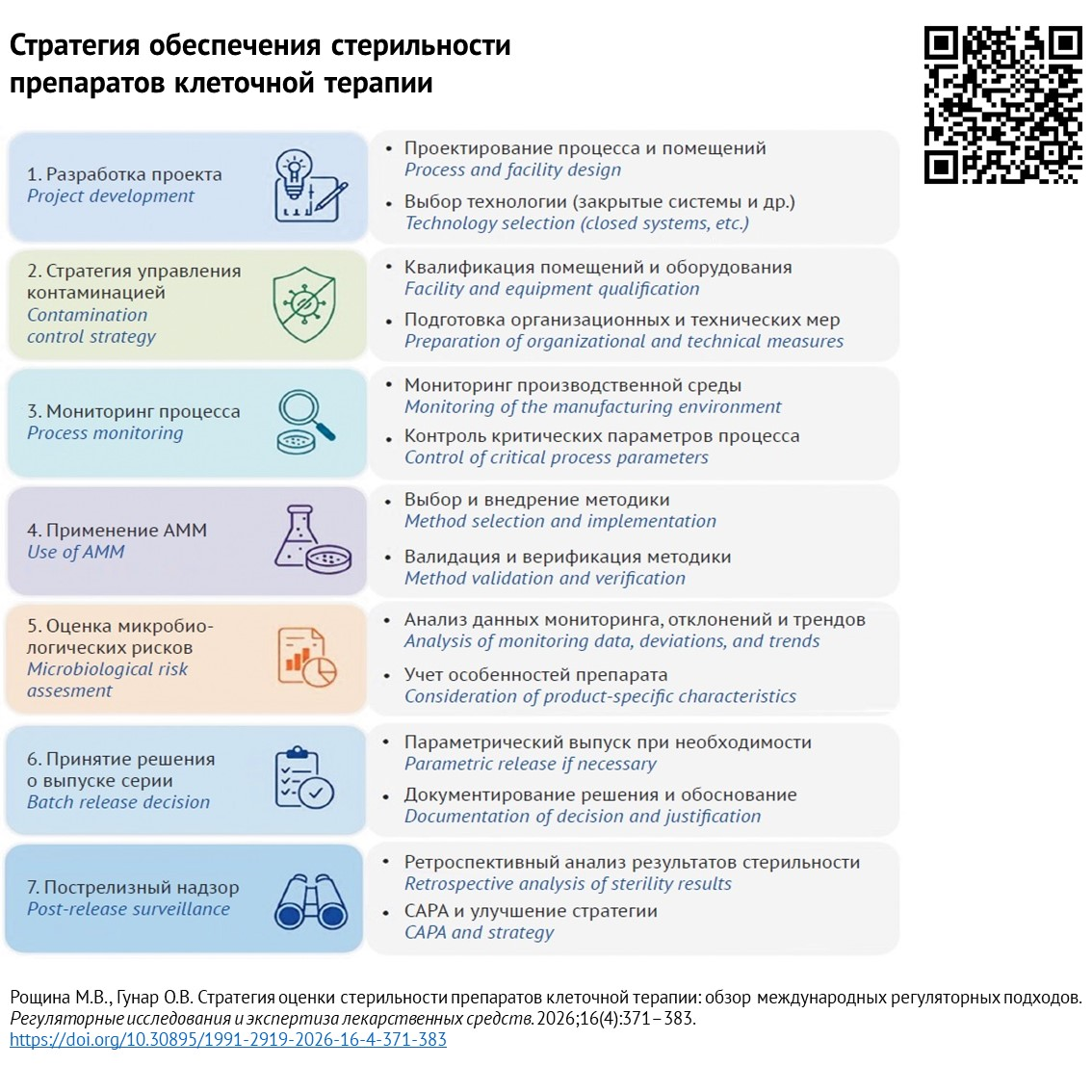
INTRODUCTION. Cell-based medicinal products are among the most complex biomedical medicinal products, with manufacturing processes associated with a high risk of microbial contamination and the impossibility of terminal sterilization. Ensuring the sterility of these products requires the implementation of a comprehensive risk-based microbiological control system throughout all stages of the manufacturing process.
AIM. A review of current approaches to developing a sterility assessment strategy for cell-based medicinal products.
DISCUSSION. The analysis demonstrated that conventional pharmacopeial sterility testing approaches have limited applicability to cell-based medicinal products due to their short shelf life, limited sample volume, and the interference of cellular components with microbiological test results. The major sources of contamination are starting biological material, personnel, the manufacturing environment, equipment, culture media, and transportation stages. Current international GMP, EMA, FDA, PIC/S, and EAEU requirements are focused on the implementation of a contamination control strategy, continuous monitoring of aseptic processes, and a risk-based approach. Alternative rapid microbiological methods are becoming increasingly important, as they significantly reduce the time required to obtain results and improve the speed of batch release decision-making.
CONCLUSIONS. The modern strategy for sterility assessment of cell-based medicinal products should be based on an integrated microbiological risk management system that incorporates aseptic manufacturing, monitoring of critical process parameters, a contamination control strategy, and the use of validated alternative microbiological testing methods. Such an approach improves the reliability of microbiological safety assurance for cell-based medicinal products throughout all stages of their manufacturing and clinical application.

INTRODUCTION. The current regulatory framework of the Republic of Kazakhstan does not provide for a special legal regime governing the compounding and circulation of radiopharmaceutical medicinal products (RMPs) in healthcare organizations. As a result, the requirements of legislation regulating pharmacy operations, pharmaceutical manufacturing, and medical activities apply to this sphere simultaneously, creating legal uncertainty and difficulties in the application of legislation. This necessitates the development of a differentiated approach to the legal regulation of this activity.
AIM. To analyze the legal and regulatory framework for in-hospital compounding of radiopharmaceutical medicinal products in the Republic of Kazakhstan and to assess the compliance of current requirements with the practical conditions of healthcare organizations' activities.
DISCUSSION. Pharmacy compounding of RMPs in the Republic of Kazakhstan is regulated by several normative legal acts belonging to different regulatory regimes: pharmaceutical, medical, and radiation safety. The Code “On Public Health and the Healthcare System” exempts pharmacy‑compounded radiopharmaceutical medicinal products from state registration; however, it does not establish a specialized regulatory model for this category of products. The Good Pharmacy Practice (GPP) standard is primarily oriented toward non-radioactive medicinal products and does not fully account for the specific characteristics of radiopharmaceutical medicinal products. The Standard for the Organization of Medical Care in the Field of Nuclear Medicine introduces requirements that are close to an industrial manufacturing model, including infrastructure elements and quality systems comparable to Good Manufacturing Practice (GMP) principles. While such an approach is reasonable for large-scale production facilities, it appears excessive for healthcare organizations that prepare RMPs solely for their own clinical use. The analysis revealed the need to develop a dedicated set of regulatory legal acts based on a risk-oriented approach, taking into account the dual nature of RMPs as both medicinal products and sources of ionizing radiation.
CONCLUSIONS. To achieve a balance between the accessibility of radiopharmaceutical technologies and the assurance of quality and safety of RMPs, it is advisable to establish a clear regulatory differentiation between the in-hospital compounding of RMPs (including their clinical use as methods of personalized medicine) and the industrial production of RMPs subject to state registration. Furthermore, it is necessary to develop a risk-based regulatory model for the preparation of medicinal products, tailored to the practical conditions of healthcare organizations' activities in the Republic of Kazakhstan. The implementation of these approaches will reduce regulatory risks, enhance legal certainty, and create a sustainable foundation for the further development of nuclear medicine in the Republic of Kazakhstan.

INTRODUCTION. According to pharmacopoeial requirements, during the development and validation of the manufacturing process for radiopharmaceuticals, it is necessary to determine the content of impurities such as Pb, As, and Fe, as well as other elements that contribute most to the contamination of the drug product (for [18F]-PSMA-1007, these elements are Al, Zn, Cu, and Li). Previously, we developed a method for quantifying elemental impurities in [18F]-fluorodeoxyglucose using inductively coupled plasma mass spectrometry. The current study aims to assess its applicability to [18F]-PSMA-1007.
AIM. Validation of the method for determining the content of Al, As, Cu, Zn, Fe, Pb and Li in the radiopharmaceutical [18F]-PSMA-1007 by inductively coupled plasma mass spectrometry.
MATERIALS AND METHODS. The tests were carried out on a sample of the radiopharmaceutical [18F]-PSMA-1007 with minimal content of the target impurities, to which varying amounts of standard solutions of the determined elements were added. The content of elements was determined using an Agilent 7900 mass spectrometer; the signal intensities of isotopes (amu) 7Li, 27Al, 57Fe, 63Cu, 66Zn, 75As, and 208Pb were recorded.
RESULTS. It was established that the method for determination of elemental impurities in the radiopharmaceutical [18F]-PSMA-1007 meets the validation requirements specified in the State Pharmacopoeia of the Russian Federation, 15th edition. The correlation coefficient of the linear dependence of signal on concentration for all determined elements is ≥0.99; the ratio of relative standard deviations at the minimum and maximum calibration levels is in the range of 0.5–2.0. The recovery of the method is characterized by acceptable accuracy (80–120%) for all determined elements. The relative standard deviation for all elements is ≤20% (repeatability) and ≤25% (intermediate precision). The actual values of the Fisher and Student test criteria are significantly below the critical values. The specificity of the method was confirmed, which allows unambiguous determination of each element in the presence of other elemental impurities and components.
CONCLUSIONS. The analytical method for determining elemental impurities by mass spectrometry in [18F]-fluorodeoxyglucose is applicable to the radiopharmaceutical [18F]-PSMA-1007. The method can be used by manufacturers of this radiopharmaceutical both for validation of their manufacturing process and, if necessary, for internal quality control of their products.

INTRODUCTION. The most important quality indicators of a radiopharmaceutical (RPh) are its radiochemical purity (RCP) or radiochemical impurity content (RCI), the values of which are standardized. Mandatory control testing of lyophilisates to assess composition, authenticity, apyrogenicity, and sterility is guaranteed by the manufacturer. Evaluation of the technetium-99m labeling process for lyophilisates, which can be influenced by numerous factors, is usually the responsibility of the end user. The methods presented in quality regulatory documents were developed in the 1970s and 1980s, and some of them require adjustment due to the upgrading of measurement instrumentation and the emergence of new materials.
AIM. To summarize the 10-year experience (2015–2025) of an accredited testing laboratory by analyzing the quality control results of 99mTc-RPhs routinely used in clinical practice, to adjust existing analytical methods specified in manufacturers’ quality documents, and to develop new ones.
MATERIALS AND METHODS. Quality control of technetium-99m radiopharmaceuticals was performed using the most significant parameters, RCP/RCI, following the methods presented in the approved quality documents of the manufacturers. The radiopharmaceuticals were prepared from lyophilisates and eluate (Na99mTcO4 solution) from 99Mo/99mTc generators of the GT-2M, GT-4K, and GT-5K types.
RESULTS. During the 10 years of operation, the accredited laboratory tested 1106 radiopharmaceuticals. Analytical methods for determining RCP/RCI based on thinlayer chromatography (TLC) were identified and tested for the radiopharmaceuticals “Macrotech, 99mTc,” “Bromezida, 99mTc,” and “Pentatech, 99mTc,” replacing the previously used filtration and high-voltage agarose gel electrophoresis methods. For the radiopharmaceutical “Technemek, 99mTc,” a chromatographic method was tested instead of determining the radiochemical composition indicator. This method allows simultaneous determination of the technetium-99m complex with dimercaptosuccinic acid (retardation factor, Rf 0.45–0.70), free Na99mTcO4 (Rf 0.9–1.0) and hydrolyzed reduced technetium-99m (Rf 0–0.15).
CONCLUSIONS. Of the total number of radiopharmaceuticals tested over the 10-year period, only a limited number of radiopharmaceuticals (3.2%) had an RCP below the acceptable level. The advantages of the proposed methods lie in the simplification of the analytical procedures, which will allow their use in a medical facility immediately before administration of the radiopharmaceutical to the patient, as well as reliable determination of the most important quality indicator of the radiopharmaceutical (RCP), which is responsible for accumulation in the target organ. The developed methods can be proposed for inclusion in draft pharmacopeial monographs and to the manufacturers of lyophilisates for their incorporation into quality regulatory documents.

INTRODUCTION. Gadobutrol is a macrocyclic gadolinium-based contrast agent used in diagnostic magnetic resonance imaging (MRI). In accordance with pharmacopeial requirements, the determination of elemental impurities in this substance is mandatory. The high concentration of gadolinium in the matrix, relative to the regulated permissible limits of target impurities, necessitates specialized methodological approaches for elemental analysis.
AIM. To develop and validate a method for determining elemental impurities in gadobutrol using inductively coupled plasma mass spectrometry.
MATERIALS AND METHODS. The method was developed using model mixtures containing standard solutions of the elements analyzed (Cd, Pb, As, Hg, Co, V, Ni, Tl, Au, Pd, Ir, Os, Rh, Ru, Se, Ag, Pt, Li, Sb, Ba, Mo, Cu, Sn, and Cr). The oxidant mixtures and digestion methods were varied. Validation samples were prepared using a 200-fold dilution of gadobutrol (blank solution), to which varying amounts of standard solutions of the elements were added. The elemental content was determined using an Agilent 7900 inductively coupled plasma mass spectrometer. When selecting the measured Pt and Se isotopes, isobaric interferences arising from high concentrations of Gd in the matrix (198Pt and 82Se) were taken into account. To suppress polyatomic interference, a collision cell operated in helium mode was used. The following stabilizers were used to bind OsO4: aqueous solutions of sodium sulfite (7.5 g/L), potassium bisulfite (7.5 g/L), and thiourea (1 g/L).
RESULTS. It was found that the use of H2O2 does not result in a significant improvement in element recovery. The optimal sample preparation is microwave digestion in a 4:1 mixture of nitric and hydrochloric acids at 150 °C. Thiourea solution is the most effective stabilizing agent for obtaining accurate Os determination results. The assessed validation parameters (linearity, accuracy, repeatability, within-laboratory precision, and specificity) meet pharmacopeial acceptance criteria. The working range of the method enables the determination of all regulated elements at the levels specified by pharmacopeial requirements.
CONCLUSIONS. The developed and validated method is recommended for implementation in the assessment of risks associated with the potential adverse effects of elemental impurities introduced into the human body upon administration of the Gadobutrol medicinal product.
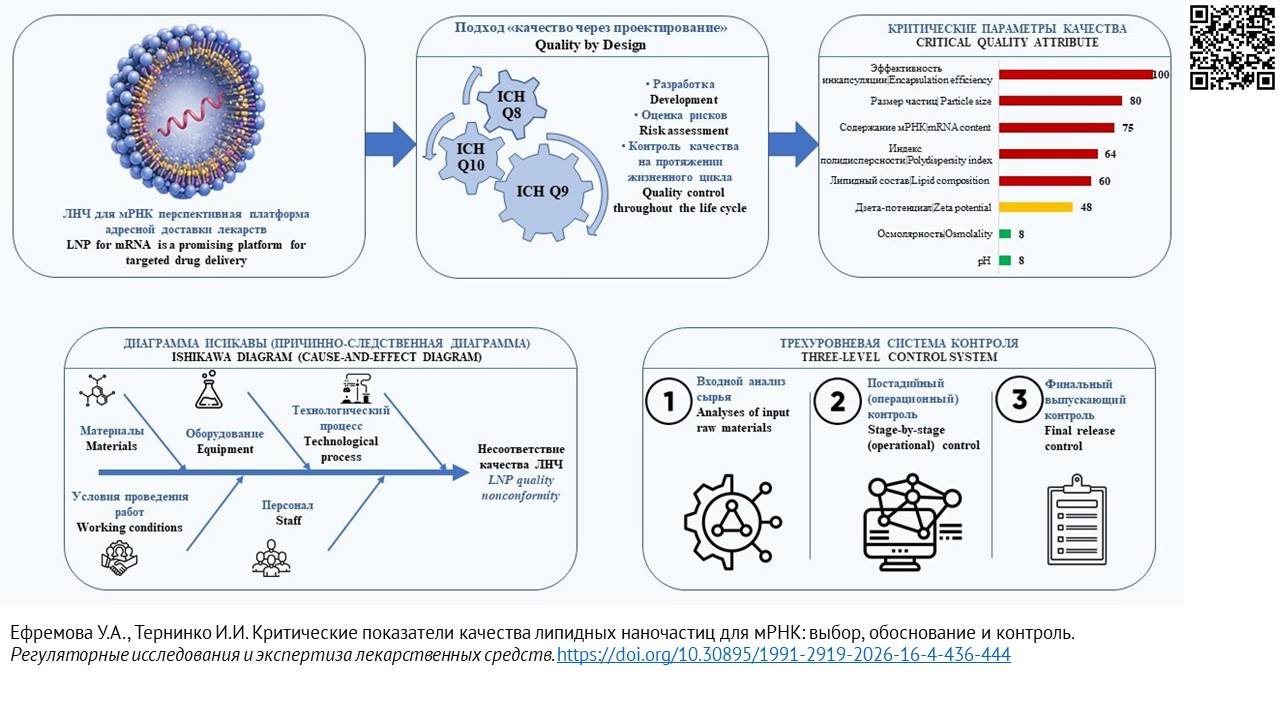
INTRODUCTION. Lipid nanoparticles represent a promising platform for targeted drug delivery, including nucleic acids, as demonstrated by COVID-19 vaccines. Unlike conventional dosage forms, lipid nanoparticles are complex supramolecular systems where the formation of critical quality attributes occurs during nanoparticle self-assembly and is not subject to post-production correction. The traditional approach based on end‑product testing is insufficient, which justifies the implementation of the Quality by Design philosophy integrating the requirements of ICH Q8, Q9 and Q10.
AIM. Systematic analysis of existing methodological approaches for the determination, assessment, and quality control of lipid nanoparticles for mRNA, and identification of critical quality attributes in accordance with the requirements of ICH guidelines Q8(R2), Q9, and Q10.
MATERIALS AND METHODS. A systematic analysis of ICH Q8–Q10 guidelines was performed. For quantitative risk assessment, the Failure Mode, Effects, and Criticality Analysis method was applied with the calculation of the Risk Priority Number (critical threshold ≥ 50). The Ishikawa diagram was used to systematically identify factors affecting the critical quality attributes of lipid nanoparticles for mRNA.
RESULTS. The highest Risk Priority Number values were obtained for encapsulation efficiency (100), particle size (80), mRNA content (75), polydispersity index (64), and lipid composition (60). pH and osmolality were non‑critical (8). Five categories of risk factors were identified: manufacturing process, equipment, raw materials, working conditions, and personnel. Based on the identified critical quality attributes for mRNA, a three‑level manufacturing control strategy was developed for lipid nanoparticles for mRNA: incoming raw material control, in‑process control using Process Analytical Technology, and final release testing with validated methods according to ICH Q2(R2).
CONCLUSIONS. The implementation of Quality by Design in the development and manufacturing of lipid nanoparticles for mRNA is scientifically justified. The proposed approach, including Failure Mode, Effects, and Criticality Analysis and the Ishikawa diagram, can be adapted for specific processes and products. Based on the identified critical quality parameters, a three-level quality strategy was developed covering every stage of lipid nanoparticle manufacturing for mRNA.

INTRODUCTION. Medicinal oxygen is a vital medicinal product. The current General Pharmacopeial Monographs (GPM; in Russian, OFS) of the 15th edition of the State Pharmacopoeia of the Russian Federation (SP RF), regarding the control of impurities in medicinal gases, are excessively voluminous and duplicate the requirements of the Pharmacopeial Monographs (PM; in Russian, FS), which complicates their practical application. The standards require updating based on international harmonization, taking into account the national specifics of analytical control.
AIM. To systematize and comparatively analyze global and national quality standards for medicinal oxygen to optimize the structure and content of the GPMs and PMs of the SP RF.
MATERIALS AND METHODS. A comparative analysis of monographs from leading foreign pharmacopeias (European Pharmacopoeia [Ph. Eur.], United States Pharmacopeia [USP], Indian Pharmacopoeia [IP], Pharmacopoeia of the People’s Republic of China [ChP], Japanese Pharmacopoeia [JP], and State Pharmacopoeia of the Republic of Belarus [SP RB]) and draft GPMs/PMs of the 15th edition of the SP RF was conducted. The requirements for medicinal oxygen were evaluated depending on the production method (cryogenic rectification and short-cycle unheated adsorption). RESULTS. It was established that international pharmacopeias regulate the quality of medicinal oxygen regardless of the production method, relying on highly selective physicochemical methods. Discrepancies in the impurity limits between the USP, Ph. Eur., and IP were identified. The case for retaining gas chromatography in Russian practice, successfully implemented both in domestic production control and in control laboratories, has been substantiated, provided that the general approaches to describing methods in the GPMs are harmonized.
CONCLUSIONS. A strategy differentiating methodological approaches was developed: the GPMs contain general testing principles, while the PMs specify the specific analytical parameters. Draft PMs for medicinal oxygen (93%, liquid, and compressed) have been prepared and approved, ensuring a balance between integration into international standards and retention of proven national competencies.

INTRODUCTION. Cyclosporine is an immunosuppressive agent used in organ trans plantation, for the treatment of autoimmune diseases, and also in ophthalmology. Cyclosporine-based medicinal products (MPs) are registered in the Russian Fede ration in various dosage forms (DFs); the most widely used are “capsules” and “oral solution”. Since the State Pharmacopoeia of the Russian Federation (SP RF) does not include pharmacopeial monographs for the pharmaceutical substance (PS) and DFs of cyclosporine, it is relevant to conduct a comparative analysis and summarize the requirements of foreign pharmacopeias regarding the control of their quality.
AIM. To perform a comparative analysis and summarize the requirements of foreign pharmacopeias for the quality of cyclosporine-based medicinal products (selection of quality attributes, regulatory requirements, and analytical methods) in order to prepare recommendations for drafting a national pharmacopeial monograph for the pharmaceutical substance cyclosporine and for developing corresponding specifications for cyclosporine-based medicinal products in the dosage forms “cap sules” and “oral solution”.
DISCUSSION. To define the pharmacopeial quality standards for the PS of cyclospo rine, the current monographs of the European Pharmacopoeia (Ph. Eur.), British Phar macopoeia (BP), United States Pharmacopeia (USP), Indian Pharmacopoeia (IP), Phar macopoeia of the People’s Republic of China (ChP), International Pharmacopoeia (IntPh), and Japanese Pharmacopoeia (JP) were analyzed; for the DFs of cyclosporine, the monographs included in the USP, IP, BP, and ChP were analyzed. As a result of the analysis, the following attributes were identified for inclusion in the phar macopeial monograph for the PS of cyclosporine in the SP RF: “Description”, “Solu bility”, “Identification”, “Clarity of solution”, “Color of solution”, “Specific rotation”, “Related substances”, “Loss on drying”, “Bacterial endotoxins”, “Microbiological puri ty”, “Heavy metals”, “Sulfated ash”, and “Assay” along with their acceptance criteria and determination methods (infrared [IR] spectrometry, ultraviolet [UV] spectro metry, and high-performance liquid chromatography [HPLC]). Data on impurities (process-related impurities formed during fermentation; degradation products) and the control of their content in the PS of cyclosporine were summarized. Methods for the identification of the active substance in the DFs of cyclosporine (a combination of two methods, e.g., HPLC and thin-layer chromatography [TLC]) and for the assay of cyclosporine (HPLC) were determined; assay limits were established, as well as specific attributes requiring control: for the “capsules” DF, “Dissolution” and “Uni formity of dosage units”; for the “oral solution” DF, “Ethanol content” (if ethanol is used as a solvent), “Deliverable volume” (if a multidose package is used), and “Uniformity of mass (volume) of doses” (if a dosing device is used).
CONCLUSIONS. Based on the results of the comparative analysis and summariza tion of the requirements of foreign pharmacopeias for the PS of cyclosporine and cyclosporine-based MPs in the DFs “capsules” and “oral solution”, recommendations were prepared for the development of a pharmacopeial monograph in the SP RF for the PS of cyclosporine and corresponding specifications for cyclosporine-based MPs in the DFs “capsules” and “oral solution”, covering identification methods, im purity limits, and the inclusion of other necessary attributes.
METHODICAL APPROACHES
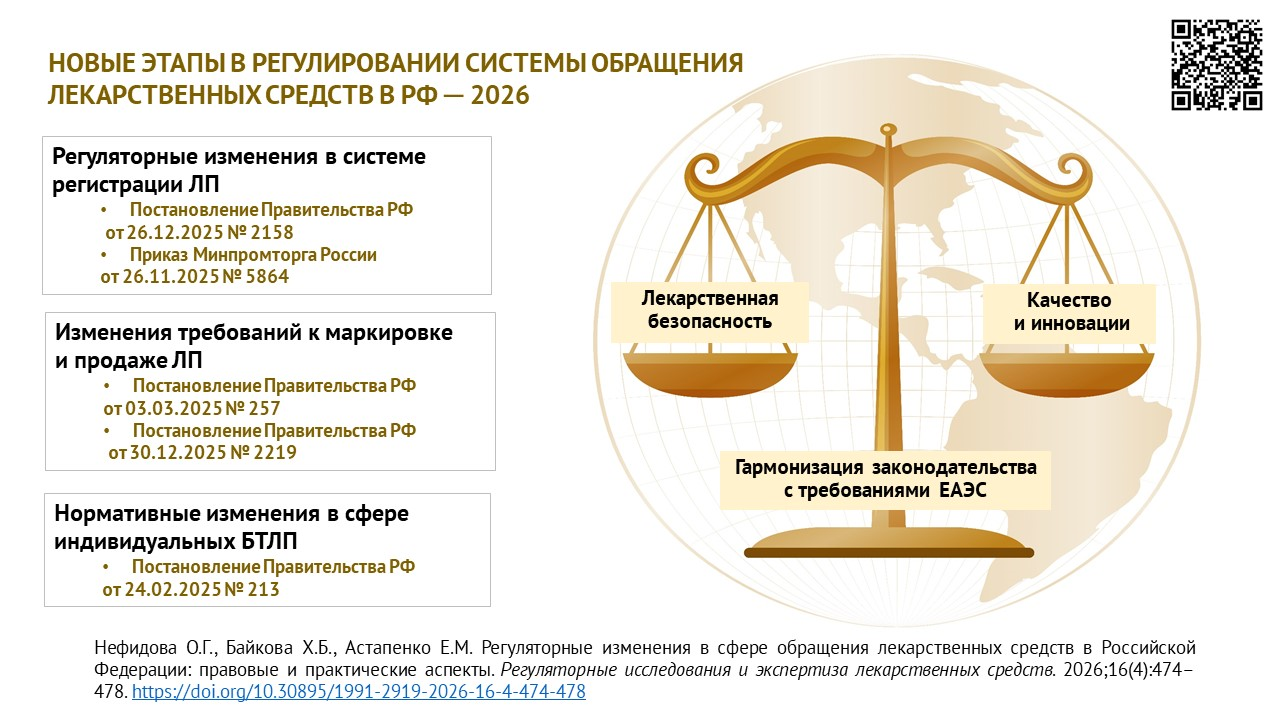
In the context of the transition to a common market for medicinal products within the framework of the Eurasian Economic Union (EAEU) and further har monization of national legislation with supranational requirements, assessment of the impact of regulatory framework updates on the development of the Rus sian pharmaceutical sector is of great importance. A sequential analysis of cur rent regulatory legal acts was carried out. Key provisions approved by the new documents that entered into force in the Russian Federation in early 2026 in connection with the transition to the common market for medicinal products in the EAEU include extension of the validity of national registration certifi cates, transition to the unified registration rules in the EAEU, and regulation of the manufacturing and circulation of individual biotechnological medicinal products. These regulatory changes are aimed at creating a balanced system of circulation of medicinal products, on the one hand, ensuring the continuity of the supply of medicinal products to the population and minimizing the risk of shortages of these products, and, on the other hand, improving their quality and safety. Of particular importance is the development of regulatory frame work for personalized medicine, which opens up new opportunities for the treat ment of serious diseases using innovative technologies.
News
2026-09-01
Правовые основы передачи генетических данных человека
С 1 сентября 2026 года вступил в силу Федеральный закон от 20.02.2026 № 43-ФЗ, который вносит изменения в регулирование генно-инженерной деятельности и устанавливает правовые основы передачи генетических данных за пределы Российской Федерации.
| More news... |

ISSN 3034-3453 (Online)


