



Contents
Scroll to:
 E. V. Avdeeva,
N. R. Varina,
T. K. Ryazanova,
V. A. Kurkin,
N. V. Isakova,
L. T. Volova,
D. A. Poltoretskii
E. V. Avdeeva,
N. R. Varina,
T. K. Ryazanova,
V. A. Kurkin,
N. V. Isakova,
L. T. Volova,
D. A. Poltoretskii https://doi.org/10.30895/1991-2919-2025-724
Scroll to:
INTRODUCTION. A holistic understanding of the physiological and biochemical pathways involved in pathogenesis is needed both for doctors diagnosing and treating patients and for drug developers. The accumulated knowledge in medicine and related fields, combined with the rapid development of digital tools, enables simulating the response systems of the body under normal and pathological conditions at a qualitatively new level. Being able to perform such simulations will lead to creating a digital architecture of body conditions, with interconnected links in the chain of pathogenesis being the focal points for researchers advancing medicines from early development to clinical trials.
AIM. This study aimed to review the existing approaches that could form a foundation for constructing an aetiopathogenetic architecture of pathological conditions and diseases that would serve as a framework for targeted drug development.
DISCUSSION. Using gout as a case study, the authors demonstrated the necessity and possibility of developing a three-dimensional aetiopathogenetic architecture of pathological conditions and diseases that would be based on the hierarchical relationships of pathological processes at different biological organisation levels. The study identified key applications for the aetiopathogenetic architecture. In medicine, the aetiopathogenetic architecture could be used in data-driven individual diagnostics and personalised pharmacotherapy. In pharmaceutics, the aetiopathogenetic architecture could provide a platform for investigating pharmacodynamics, from screening candidate compounds to applying targeted and multitargeted approaches in pharmaceutical development. The authors used the aetiopathogenetic architecture of gout as a case study to discuss the logic behind designing studies of medicines.
CONCLUSIONS. The article proposes a methodology for constructing an aetiopathogenetic architecture reflecting cause-and-effect relationships of different significance to the development of pathological conditions and diseases. The aetiopathogenetic approach should become an integrative framework for all stages of the development and use of novel medicines, as well as a basis for expanding the indications for existing medicines. New opportunities are arising for the development of aetiopathogenetic models of varying complexity that can be used in projects ranging from drug design at the molecular level to pathophysiological modelling at the organismal level.
Avdeeva E.V., Varina N.R., Ryazanova T.K., Kurkin V.A., Isakova N.V., Volova L.T., Poltoretskii D.A. Aetiopathogenetic Architecture for Pharmaceutical Development (Using Gout as a Case Study). Regulatory Research and Medicine Evaluation. 2025;15(6):642-654. https://doi.org/10.30895/1991-2919-2025-724
Currently, the nosological approach dominates in the diagnosis and treatment of diseases, primary and secondary prevention, as well as rehabilitation. It uses disease symptoms confirmed by physical and laboratory findings, which is undoubtedly an effective basis for physicians to work on. The medical and pharmaceutical community is guided by ICD-10 and the transition to ICD-11. Clinical guidelines and medical care standards approved by the Russian government are a valuable basis for medical care standardisation (see Guidelines1). At the same time, medical scientists, biologists, and drug developers are looking for ways to reach a new level of understanding for this pathology and to move from disease treatment to patient treatment, namely affecting the body as an integrated system of interrelated processes.
The amount of empirical evidence, clinical observations, alongside with the emerging medical information systems and databases, IT applications using artificial intelligence (AI), and drug design platforms make it possible to fully switch to pathogenetically based pharmacocorrection, thus embodying the concept of 4P Medicine (prediction, prevention, personalisation, and participation) and 5P Medicine (+precision medicine) [1–4].
In our opinion, use of already known pathophysiological and pathobiochemical knowledge2 is therefore required to build a system of body reactivity: from general pathologies through clusters of associated processes to more specific and localised body reactions, resulting in diagnosis, primary and secondary prevention, treatment and rehabilitation3. This system of interrelated processes should have a multidimensional architecture, similar to the body volumetric system. To construct the system seems to be a complex combinatorial goal. Currently, transition to a new qualitative level of structuring medical knowledge and care is available (outcome prediction, personalised drug and non-drug treatment, decision support system for the doctors, lifestyle prescriptions, logistics, cost planning etc.). This dynamic architecture requires identifying etiopathogenetic relationship of processes and their clinical manifestations over time, with the corresponding extensive medical data (medical images, pathological anatomy, pathological biochemistry, immune homeostasis, genetic data etc.). This system should integrate several purposes: a fundamental understanding of cause-and-effect relationships, conditions of specific pathologies and their combinations, treatment personification, and drug development4. This will require new digital solutions, such as mathematical modeling, data management, machine learning, and large computing capacities [5].
Currently, individual blocks are under active development (most of them in oncology and cardiology), including university teams (St. Petersburg State University, Sechenov Medical University, Pirogov Russian National Research Medical University, Samara State Medical University etc.) [6–9]. In our opinion, further joint efforts will make it possible to build an integrated architecture, dynamically complemented by new data on pathogenesis and effects of biologically active substances.
This study aimed to review the existing approaches and use them as a foundation for aetiopathogenetic architecture of conditions and diseases used for choosing drug development options.
The databases and library systems used to search for this review: PID; Reactome; BRENDA; KEGG; eLIBRARY.RU; Scopus; PubMed; PubChem; Cyberleninka, as well as materials from the official websites of the U.S. Food and Drug Administration (FDA), and European Medicines Agency (EMA).
The search in the above databases was carried out using the following search terms and/or their combinations: "aetiopathogenesis", "drug development", "hierarchy of pathological conditions", etc. Relevant data were selected manually according to relevance and significance criteria. A total of 75 articles on the subject of the review were selected as the most significant. The keyword search depth is 15 years.
Medical progress in physical examination, pathobiochemistry, and in generating and processing medical images allow for assessment of specific normal or pathological phenomena and processes in measurable quantities and aetiopathogenetic substantiation for diseases [10–13].
From the perspective of specialists studying process pharmacodynamics, the vertical architecture of process continuity and manifestations over time is of particular interest [14–15]. It is created by linking the processes at the molecular, cellular, tissue, organ, and organ system levels of biological organisation. This should be used to introduce importance weighting of pathophysiological processes in the development of pathology [16–20].
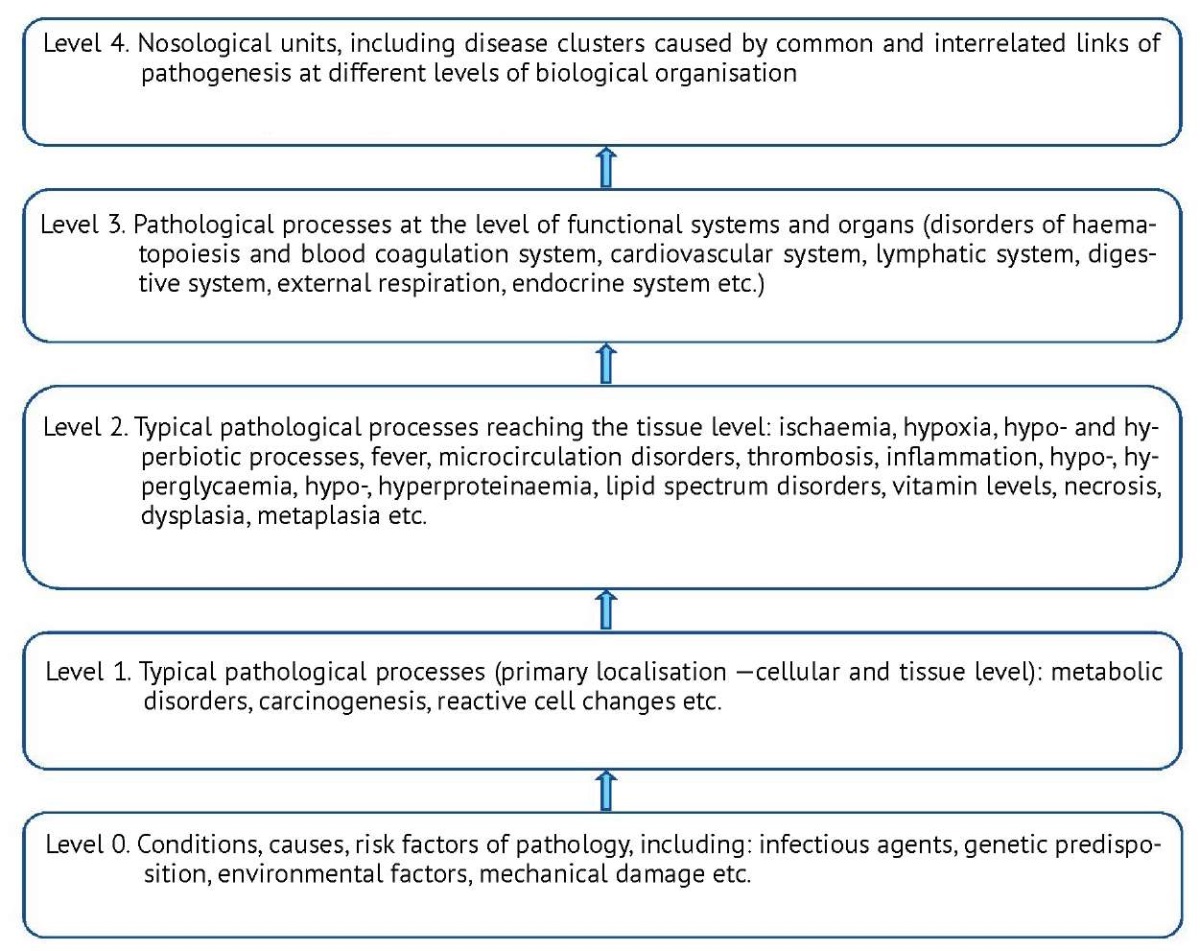
It is appropriate to represent the hierarchy of pathological processes by several levels (Fig. 1), where each subsequent level of pathology localisation and manifestation is determined by processes of the underlying level.
The figure is prepared by the authors
Fig. 1. Schematic representation of the hierarchy of pathological processes
Level 1. Defines the processes at the molecular, genetic and cellular levels - general pathological / typical processes / not tied to specific systems and organs, initiated by various aetiological causes and factors (level 0), as well as horizontal interactions of general pathological processes. These include metabolic disorders of proteins, fats, and carbohydrates; mineral metabolism; energy metabolism, reactivity disorders, inflammation, cancerogenesis and some other.
Level 2. Typical body reactions (common links of pathogenesis) manifested at the tissue level: a balance shift in the "prooxidant – antioxidant" system; changes in the lipid spectrum and cholesterol disorders; disorders of thermoregulation, water-electrolyte balance, acid-base balance, immune homeostasis, adaptation mechanisms; hypoxia, shock, stress etc.
Level 3. Pathological processes localised at the level of functional systems and organs that form intersecting cascades of various body reactions and create a landscape of nosological forms, including comorbid states at the organism level.
These include various manifestations associated with disorders of higher regulatory systems – neurohumoral and hormonal (overactivity of the sympathetic nervous system, cytokine storm); metabolic processes (atherosclerosis, osteoporosis, metabolic syndrome); immunodeficiency states and autoimmune processes. The interdependent processes form a vast pathogenetic network of entire clusters of conditions and further associated diseases.
Level 4. The nosological units, as well as their complexes – disease clusters formed by common and interrelated links at different organisation levels. The severity confirmed by medical data is the basis for medical (and other) decisions in diagnosing patients' conditions, preventive measures, and medical treatment.
In terms of structuring causal relationships of pathological processes, the concept of aetiopathogenetic clusters and algorithmic matrices proposed by Z. Kovač deserves special mention. Aetiopathogenetic clusters represent interrelations, intersections, and integration points of natural pathophysiological development over time [21]. At present, 91 identified clusters tend to construct a network and intercluster connections at various hierarchical levels of reactivity of the human body.
Based on this paradigm, the pathogenesis is described for almost one thousand diseases, which is valuable for the scientific community, practical healthcare professionals, and educational purposes.
In developing a systematic approach, the next step for the scientific community is to work with big data using artificial intelligence: determining the significance levels of medical data for assessing a patient’s condition, data based diagnosis, outcome prediction and the emerging new pathologies. This will make it possible to create a multidimensional and dynamic digital architecture of the body states and their interrelation, at different levels of biological organisation, in a normal and pathological state.
An example of an architecture fragment is a planar scheme we have compiled (Fig. 2). It reflects purine and uric acid metabolism disorders that underly the pathogenesis of gout, urate nephrolithiasis and other associated diseases. The aetiopathogenesis is presented in accordance with the hierarchy of pathological processes (Fig. 1); their interdependence is discussed in various publications and reviews [22–29]. The arrows indicate connections between conditions and body reactions at different levels of biological organisation; the numbers above the arrows indicate significance levels (weight) of the relationships and manifestation probability of conditions and diseases (Fig. 2).
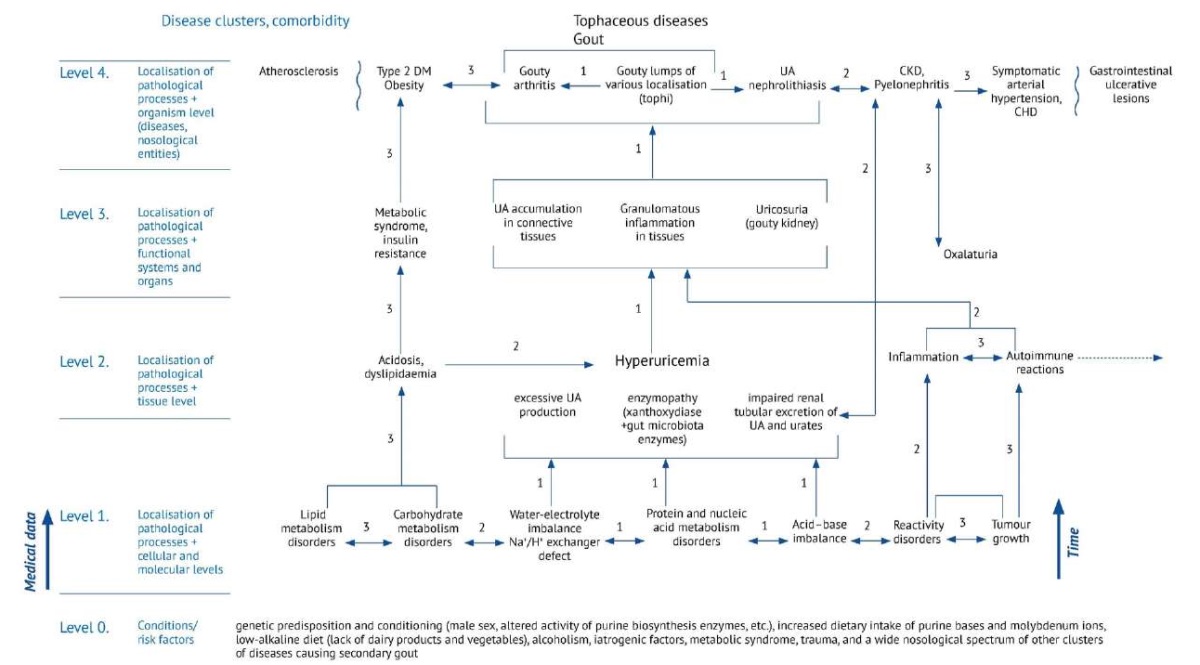
UA, uric acid, sodium monourate; CKD, chronic kidney disease; DM, diabetes mellitus; CHD, coronary heart disease
The figure is prepared by the authors
Fig. 2. Aetiopathogenetic architecture of gout (fragment)
Based on aetiopathogenetic architecture of gout (Fig. 2), it is practically significant to construct a diagram of a patient’s conditions and diseases (level 4) based on the patient's medical data related to the relevant aetiopathogenetic links [22][25][28]. In fact, a cluster of patient diseases is based on the architecture/cluster of conditions. For ease of perception, volumetric architecture of patient’s diseases is preferable as a diagram on a plane surface. Its purpose is to inform the doctor and the patient on the presence and severity of pathology(ies) in relation to time. During dynamic monitoring of the body's condition (for the data also reflected in subsequent similar diagrams), a prediction for diagnosed diseases and the risk of new diseases is assessed for a particular patient. An example of a disease cluster for patient "X" is shown in Fig. 3.

The figure is prepared by the authors
Fig. 3. The disease manifestation diagram of patient "X"
The diagnoses indicated in the model diagram, in turn, are based on the dominant pathological processes [12][13][19], which should be represented in the corresponding architectures of their conditions (similar to Fig. 2). At the same time, a multidimensional individual architecture of conditions is formed (changing over time) in the dynamics of progressing/ regressing diseases.
Thus, the outcome prediction of an existing pathology, the risks of developing diseases and early diagnosis of associated conditions and diseases, as well as appropriate decision–making can increasingly use data (with meta-data and meta-analysis as median values) and be reflected in the multidimensional digital architecture of body conditions. In addition, it can be a guideline for development and personalised use of medicines as a combined effect on several pathogenetic links, as well as on a specific target [30–35].
Both for fundamental understanding of of various pathological conditions and for studying the effects of biologically active susbtances, aetiopathogenetic architecture can be implemented, starting from the screening of drug candidates and up to the post-marketing study of medicinal products.
Recently, there has been a paradigm shift of drug development from “classical” function-oriented approaches (biological effects of potential drugs assessed at the tissue or body level; “phenotype-directed” drug search; biomimetic approach etc.) with subsequent mechanistic studies to later target-based approaches; initial analyses usually includes evaluating drug interactions with certain (and often cloned recombinant) proteins in silico and in vitro (target–directed drug search), then in vivo models. In this regard, the hierarchical levels 0–2 turned out to be a priority for developers (Fig. 1) [36][37].
As described, pathological processes at different levels of biological organisation are based on molecular changes, which are the study subject in a number of modern scientific directions. Various approaches are used to identify therapeutically significant targets and/or signaling pathways, such as identification of disease-causing genes [38], results of transcriptomic [39][40], proteomic [41–45], metabolomic [46][47], and multiomic studies, including those processed using machine learning algorithms [48–50]. The most comprehensive data sources on the processes occurring at the molecular and cellular levels are databases on signal transduction Pathway Interaction Database (PID) [51], Reactome, and BRENDA/ KEGG databases on metabolic pathways.
At the same time, researchers note the reductive effect of the currently dominant target-oriented drug search and its insufficient effectiveness. Over time, this may cause a development crisis of low-molecular-weight drugs [52]. Some researchers suppose that the main theoretical drawback of target-oriented drug search is that it ignores the differences between complex and chain systems, simplifying the attitude towards structure and functions of biological processes [53][54].
A recent systematic review of about 32,000 articles and patents published over the past 150 years demonstrated that a total of 9.4% of registered medicines were detected using a "target-oriented" search. In addition, biological effects unrelated to the main mechanism of action have been identified for these drugs [52]. At the same time, a target-oriented approach to drug search can be highly effective in some diseases caused by one or more proteins (for example, monogenic Mendelian disorders). The use of a target-oriented approach is an important asset for developing "next in class" drugs that helps to modify, clarify structures and subsequently create best-in-class drugs [55].
According to a hypothesis, prioritising higher-level observations in the pathogenetic hierarchy for selection and optimisation of molecules can increase the search performance of first-in-class effective drugs. The success of this approach is confirmed by registration of Russia's first–in-class drug, a monoclonal antibody against the TRBV9 segment of the T-cell receptor [56].
The search for better results in clinical practice due to insufficient effectiveness of "one target, one molecule" paradigm led to the development of polypharmacology concept as a new therapeutic strategy. It involves combining various structural subunits in one framework, which allow for molecular recognition by more than one bioreceptor acting simultaneously on several targets connected by biochemical networks responsible for the disease pathophysiology [57].
Rationally developed multi-targeted drugs (also called multimodal or multifunctional drugs) have become an attractive choice for discovery of biologically active substances over the past 10–20 years as potential therapeutic solutions for diseases of complex aetiology and multidrug resistance [58-60]. Due to low-affinity binding (or partial agonism in some cases), multitarget drugs can avoid the frequent double trap of drug resistance and toxicity. At the same time, "non-selective non-selectivity" should be avoided for designed multi-targeted drugs, as this can lead to serious safety problems [61]. Various approaches are used for medical and chemical design of multi-targeted drugs, including those with non-overlapping, partially overlapping, and fully integrated "pharmacophores" [62].
An example of successful polypharmacology concepts are 86 multi-target drugs approved by the FDA among 462 new molecular compounds over 2000–2017 [63][64]. Multi-target medicines approved for use in 2023–2024 are:
Examples of multi-target drugs are plant-derived biologically active substances, most of them with a favorable toxicity profile [64–67].
Understanding diseases etiopathogenesis and comparability of pathological reactions in different conditions also makes it possible to extend the indications for authorized medicinal products (drug repurposing). Repurposing of a medicinal product available on the market allows for an immediate start of phase II research [68]. This reduces costs, since repurposing an existing drug costs about five (5) times less compared to registering a new drug [69].
Based on clinical observations or biologically relevant modeling, a pathogenesis concept of a particular disease and combined pathology (disease clusters) is formed and clarified from level 4 to level 0 (Fig. 1). Understanding pathophysiology and quantifying the parameters is an experimental platform for screening and developing drugs or for expanding indications/ contraindications for medicinal products that are already in use.
The authors of article [70] state that “cardioprotective properties of drugs with known anti–gouty effects and anti-inflammatory properties explained by inflammasome inhibition or blocking biological effect of its end products (interleukins) are a new milestone in cardiology.” In other words, a specific molecular target is indicated – the NLRP3 inflammasome [71] at the level 1 (Fig. 2), which should be one of the focuses in drug development and screening of biologically active substances, affecting the subsequent pathogenesis hierarchy to the organism level (Fig. 3).
According to Figure 2, hyperuricaemia should be considered a proinflammatory trigger in tissues and organs (significance level 1), causing tofuses, arthropathy, kidney and cardiovascular damage (level 3 and 4) [72]. However, for the vast majority of patients with prolonged hyperuricaemia, gout does not develop. Similarly, according to meta-analysis, hypercholesterolaemia, a proven atherogenetic factor, does not result in relevant clinical events in all patients [73]. These observations can be explained by pathological processes that lie deeper, such as universal inflammation at levels 1 and 2 of biological organisation (Fig. 1 and 2). Their contribution to aetiopathogenesis is indicated by the second level of significance (Fig. 2). Interleukin-1b, a product of NLRP3 inflammasome activation, is a multiprotein complex responsible for local inflammatory response in the synovial membrane and periarticular tissues involving macrophages and neutrophils (incomplete phagocytosis), recognised as a key mediator of acute gout attacks.
At the cellular level, the NLRP3 inflammasome is activated by uric acid crystals and cholesterol only after activating by lipopolysaccharides, peroxidation products, and other damage factors associated with aging and comorbid conditions typical for gout and cardiovascular diseases [71–73]. Besides, activity of the NLRP3 inflammasome is genetically determined and defines frequency of these conditions (additionally, level 0). The discussed etiopathogenetic mechanism explains why exposure to comorbidity-related factors (NLRP3 inflammasome) can reduce gout attacks along with cardiovascular outcomes.
At the integration level of disease clusters (level 4), clinically significant pleiotropic effects of statins and type 2 sodium-glucose transporter inhibitors have advantages over urate-reducing therapy in asymptomatic hyperuricaemia and are able to modify gout outcome. Their anti-inflammatory properties, cardio- and renoprotective effects, and advanced tolerability are being studied [70]. Blocking the inflammasome activity is a new universal/common therapeutic target for rheumatology and cardiology, especially in increased cardiovascular risk associated with hyperuricaemia [70–73].
There are two major test systems at the cellular level: inflammatory response and gout condition. In vitro cellular test systems are based on the primary human cell cultures, a priori known as cells involved in the pathogenesis. For example, to simulate hyperuricaemia conditions in vivo, a unique in vitro cellular test system was developed for stimulating blood cells of individual donors with uric acid [74]. Using the developed hyperuricaemic hemotest system in vitro, quantitative differences were found in the production of inflammatory cytokines produced by blood cells of potentially healthy donors and patients with hyperuricaemia and gouty arthritis. This hyperuricaemic hemotest system can serve as an in vitro cellular model for studying activation of signaling molecules of inflammasome inflammation in gouty arthritis. Moreover, it can be used for screening drug candidates.
The next stage is pathology modelling in animal experiments widely represented in both Russian and international practice of preclinical (experimental) research. However, in some cases, collecting sufficient and appropriate data at a higher level (3 and higher) may be inefficient, burdensome, and require a large number of animals. At the same time, data obtained at lower levels of the pathophysiological hierarchy (level 2 and below) can be based on knowledge of system biology, systemic pharmacology, and large-scale modelling [75]. Equally promising is a phenotypic approach to modelling the aetiopathogenesis considering significance levels for the disease manifestation. Measurability of the preset and determined parameters of pathology is also relevant, since it will provide structured data for digital platforms for assessing body conditions and developing drugs.
Analysis of published data in pathophysiology, pathobiochemistry, pathogenesis of diseases and conditions, and drug development has allowed the researchers to create a methodology for constructing a multidimensional architecture of body conditions based on medical data.
The architecture implements a well-known aetiopathogenetic approach, but with an emphasis on pathophysiological progression at different levels of biological organisation over time, with a prediction of probable disease manifestation based on the significance weights for emerging pathogenesis links.
The proposed architecture can be used in several ways. It is applicable in medical practice: from primary prevention to diagnosis and treatment of a particular patient. Regarding drug development, it can become an integrative framework for all stages of drug development, used to design a preclinical study, starting with the virtual screening of a drug candidate and subsequent selection of test systems of various complexity. The approach is applicable both for the development of new drugs and for expanding indications and expected effects for the authorised medicinal products.
Authors’ contributions. All the authors confirm that they meet the ICMJE criteria for authorship. The most significant contributions were as follows. Elena V. Avdeeva and Natalia R. Varina developed the review concept, analysed the scientific literature, regulatory and patent documentation, developed the concept of aetiopathogenetic architecture of body conditions, and wrote the manuscript. Tatyana K. Ryazanova and Vladimir A. Kurkin carried out a critical analysis of the existing approaches in the medicine development, assessed the prospects for their targeted development based on aetiopathogenetic approach, edited the text of the manuscript and approved the final version for publication. Natalia V. Isakova and Larissa T. Volova carried out a critical analysis of the pathophysiological approach in fundamental biomedical researches and in real medical practice and developed a modern concept of the pathogenetic approach in assessing conditions and pathogenesis. Denis A. Poltoretskii carried out a critical analysis of digital tools and available platform solutions for processing medical data, digitally modelled the cause-and-effect relationships in the pathogenesis, and designed the graphic material of the manuscript.
Вклад авторов. Все авторы подтверждают соответствие своего авторства критериям ICMJE. Наибольший вклад распределен следующим образом: Е.В. Авдеева, Н.Р. Варина — разработка концепции обзора, анализ данных научной литературы, нормативной и патентной документации, разработка концепта этиопатогенетической архитектуры состояний организма, написание текста рукописи; Т.К. Рязанова, В.А. Куркин — критический анализ существующих подходов в создании лекарственных средств, оценка перспектив их целенаправленной разработки на основе этиопатогенетического подхода, редактирование текста рукописи и утверждение окончательного варианта для публикации; Н.В. Исакова, Л.Т. Волова — критический анализ использования патофизиологического подхода в фундаментальных медико-биологических исследованиях и в реальной медицинской практике, разработка современного концепта патогенетического подхода в оценке состояний и развитии заболеваний; Д.А. Полторецкий — критический анализ цифровых инструментов и имеющихся платформенных решений по обработке медицинских данных, моделирование в «цифре» причинно-следственных связей в развитии патологии, оформление графического материала рукописи.
1. Association of Rheumatologists of Russia. Gout. Clinical recommendations. 2018.
Scientific and Clinical Center of Endourology. Urolithiasis. Clinical recommendations. 2020.
2. Zaichik A. Sh., Churilov L. P. Pathological physiology. Vol. 2. Pathochemistry. St. Petersburg: ELBI-SPb; 2007.
3. Glybochko P.V., Alyaev Yu. G., Grigoriev N. A. Urology. From symptoms to diagnosis and treatment. Moscow: GEOTAR-Media; 2014.
4. Kurkin V. A., Akimova N. L., Avdeeva E. V., Yezhkov V. N., Petrukhina I. K. The immune system and immunocorrectors. Samara: Ofort; 2010.
1. Dedov II. Personalized medicine. Annals of the Russian Academy of Medical Sciences. 2019;74(1):61–70 (In Russ.). https://doi.org/10.15690/vramn1108
2. Dolgopolov IS, Rykov MYu. The evolution of personalized medicine: Literature review. Research and Practical Medicine Journal. 2022;9(3):117–28 (In Russ.). https://doi.org/10.17709/2410-1893-2022-9-3-9
3. Khokhlov AL, Sychev DA. The concept of patient-oriented medicine and pharmacy. Patient-Oriented Medicine and Pharmacy. 2023; 1(1):1–4 (In Russ.). https://doi.org/10.37489/2949-1924-0001
4. Shcherbo SN, Shcherbo DS. Laboratory diagnostics as the basis of medicine of 5P. Bulletin of RSMU. 2019;(1):5–14 (In Russ.). https://doi.org/10.24075/brsmu.2018.095
5. Trocin C, Mikalef P, Papamitsiou Z, Conboy K. Responsible AI for digital health: A synthesis and a research agenda. Inf Syst Front. 2023;25:2139–57. https://doi.org/10.1007/s10796-021-10146-4
6. Germanov NS. The concept of responsible artificial intelligence as the future of artificial intelligence in medicine. Digital Diagnostics. 2023;4(1S):27–9 (In Russ.). https://doi.org/10.17816/DD430334
7. Kolsanov AV, Sedashkina OA, Poretskova GYu, Plakhotnikova SP, Postnikov MA, Beschastnaya EO. Clinical, paraclinical and molecular genetic indicators of children with chronic kidney disease, which should be subject to dispensary observation in the Samara region. Certificate of registration of the database of the Russian Federation No. 2024622010; 2024 (In Russ.). EDN: QTUISW
8. Avdeeva EV, Voronin AS, Erkhov VYu. A program for the study of medical disciplines based on the principle of a multidisciplinary nosological approach “3D structure of knowledge”. Certificate of registration of the computer program of the Russian Federation No. 2021619194; 2021 (In Russ.). EDN: PQKMJX
9. Pakhomov VA, Sobolevskaya PA, Kuznetsov AV, Churilov LP, Normatov MG. A program for analyzing proteins for the content of overlapping amino acid sequences with human allergen proteins (Allergentaj). Certificate of registration of the computer program of the Russian Federation No. 2023685928; 2023 (In Russ.).
10. Malyshev IY, Pihlak AE, Budanova OP. Molecular and cellular mechanisms of inflammation in gout. Pathogenesis. 2019;17(4):4–13 (In Russ.). https://doi.org/10.25557/2310-0435.2019.04.4-13
11. Gavrilova NYu, Beregovskaya AV, Suprun LA, Lukashenko MV, Churilov LP, Fedotkina TV, Pchelin IYu. A method for diagnosing early neurological disorders in patients with type 1 diabetes mellitus. Patent of the Russian Federation No. 2808480; 2023 (In Russ.). EDN: GEOKMI
12. Pavlova VYu, Denisenko VE, Chesnokova LD, Aneshina II. Diagnostic possibilities of urinalysis. Fundamental and Clinical Medicine. 2022;7(4):122–35 (In Russ.). https://doi.org/10.23946/2500-0764-2022-7-4-122-135
13. Kang HS, Lee N-E, Yoo DM, Han KM, Hong JY, Choi HG, et al. An elevated likelihood of stroke, ischemic heart disease, or heart failure in individuals with gout: A longitudinal follow-up study utilizing the National Health Information data-base in Korea. Front Endocrinol (Lausanne). 2023;14:1195888. https://doi.org/10.3389/fendo.2023.1195888
14. Kachkovsky MA, Fedorina TA, Ragozina EYu, Chekuldaeva LI, Glubokov DK, Suvorov AE. Assessment of the intensity of the systemic inflammatory response to the size of myocardial necrosis according to morphometric research. Morphological Newsletter. 2013;(3):53–6 (In Russ.). EDN: SDFRPV
15. Yashin SS, Kireeva AO, Sukhachev PA. Stress-induced cardiomyopathy (Takotsubo syndrome). Innovative medicine of Kuban. 2023;8(1):111–5 (In Russ.). https://doi.org/10.35401/2541-9897-2023-26-1-111-115
16. Dadali VA. The role of cobalt, copper, molybdenum, selenium, zinc, and manganese in providing homeostatic regulation responses. Therapist. 2022;(11):36–9 (In Russ.). https://doi.org/10.33920/MED-12-2211-04
17. Gonçalves C, Macedo H, Fernandes L, Churilov L, de Carvalho J. Probiotics in rheumatic diseases: A systematic review. Russ Biomed Res. 2023;8(2):92–111. https://doi.org/10.56871/RBR.2023.39.42.011
18. Eliseev MS. Classification criteria for gout (ACR/EULAR recommendations). Scientific and Practical Rheumatology. 2015;53(6):581–5 (In Russ.). https://doi.org/10.14412/1995-4484-2015-581-585
19. Libov IA, Moiseeva YuN, Komarova AG. Hyperuricemia as a risk factor for cardiovascular events in hypertensive patients. Russian Journal of Cardiology. 2022;27(9):5194 (In Russ.). https://doi.org/10.15829/1560-4071-2022-5194
20. Ivanov MF, Balmasova IP, Zhestkov AV, Rogozina LA. The role of innate and adaptive immune response lymphocytes in pathogenesis of hemorrhagic fever with renal syndrome. ACTA Sci Med Sci. 2019;3(8):120. https://doi.org/10.31080/asms.2019.03.0357
21. Kovač Z. Pathophysiological body reactivity and interactions in comorbidities. Synergism versus antagonism of disease pathways and etiopathogenetic clusters in comorbidity conditions. Psychiatr Danub. 2021;33(4):414–26. PMID: 30946713
22. Pascart T, Latourte A, Flipo RM, Chales G, Coblentz-Baumann L, Cohen-Solal A, et al. 2020 recommendations from the French Society of Rheumatology for the management of gout: Urate-lowering therapy. Joint Bone Spine. 2020:87(5):395–404. https://doi.org/10.1016/j.jbspin.2020.05.002
23. Fitzgerald JD, Dalbeth N, Mikuls T, Brignardello-Petersen R, Guyatt G, Abeles AM, et al. 2020 American College of Rheumatology guideline for the management of gout. Arthritis Care Res (Hoboken). 2020;72(6):744–60. https://doi.org/10.1002/acr.24180
24. Gromova MA, Tsurko VV. New recommendations of the American College of Rheumatology for the patient management with gout (2020). Review on some points. RMJ. Medical Review. 2021;5(2):89–95 (In Russ.). https://doi.org/10.32364/2587-6821-2021-5-2-89-95
25. Drapkina OM, Mazurov VI, Martynov AI, Gaidukova IZ, Duplyakov DV, Nevzorova VA, et al. “Focus on hyperuricemia”. The resolution of the Expert Council. Cardiovascular Therapy and Prevention. 2023;22(4):3564 (In Russ.). https://doi.org/10.15829/1728-8800-2023-3564
26. Yanai H, Adachi H, Hakoshima M, Katsuyama H. Molecular biological and clinical understanding of the pathophysiology and treatments of hyperuricemia and its association with metabolic syndrome, cardiovascular diseases and chronic kidney disease. Int J Mol Sci. 2021;22(17):9221. https://doi.org/10.3390/ijms22179221
27. Kobalava ZhD, Troitskaya EA. Asymptomatic hyperuricemia: Treatment approaches according to the risk of cardiovascular and renal events. Kardiologiia. 2020;60(12):104–9 (In Russ.). https://doi.org/10.18087/cardio.2020.12.n1158
28. Richette P, Clerson P, Perissin L, Flipo R-M, Bardin T. Revisiting comorbidities in gout: A cluster analysis. Ann Rheum Dis. 2015;74(1):142–7. https://doi.org/10.1136/annrheumdis-2013-203779
29. Lee JK, Kim JW, Kim YS, Koo BS. A case of severe gouty tophi-induced carpal tunnel syndrome: Operative finding and its outcome. Handchir Mikrochir Plast Chir. 2018;50(1):19–21. https://doi.org/10.1055/a-0576-7299
30. Lin GL, Lin HC, Lin HL, Keller J, Wang L-H, et al. Association between statin use and the risk of gout in patients with hyperlipidemia: A population-based cohort study. Front Pharmacol. 2023;14:1096999. https://doi.org/10.3389/fphar.2023.1096999
31. Akbari A, Razmi M, Rafiee M, Watts GF, Sahebkar A. The effect of statin therapy on serum uric acid levels: A systematic review and meta-analysis. Curr Med Chem. 2023;31(13):1726–39. https://doi.org/10.2174/0929867330666230207124516
32. Yip ASY, Leong S, Teo YH, Teo YN, Syn NLX, See RM, et al. Effect of sodium-glucose cotransporter-2 (SGLT2) inhibitors on serum urate levels in patients with and without diabetes: A systematic review and meta-regression of 43 randomized controlled trials. Ther Adv Chronic Dis. 2022;13:20406223221083509. https://doi.org/10.1177/20406223221083509
33. Stamp LK, Chapman PT, Barclay ML, Horne A, Frampton C, Tan P, et al. A randomised controlled trial of the efficacy and safety of allopurinol dose escalation to achieve target serum urate in people with gout. Ann Rheum Dis. 2017;76(9):1522–8. https://doi.org/10.1136/annrheumdis-2016-210872
34. Panevin TS, Eliseev MS, Nasonov EL. Urate-lowering drugs in the treatment of gout: The unknown about the known. Rheumatology Science and Practice. 2021;59(6):727–37 (In Russ.). https://doi.org/10.47360/1995-4484-2021-727-737
35. Garanin AA, Novichkova NL, Lebedev PA. Prospects of anti-inflammatory and urate-lowering therapy of gout: A vector from the past to the future. Rheumatology Science and Practice. 2022;60(2):205–13 (In Russ.). https://doi.org/10.47360/1995-4484-2022-205-213
36. Kell DB, Goodacre R. Metabolomics and systems pharmacology: Why and how to model the human metabolic network for drug discovery. Drug Discovery Today. 2014;19(2):171–82. https://doi.org/10.1016/j.drudis.2013.07.014
37. Ha J, Park H, Park J, Park SB. Recent advances in identifying protein targets in drug discovery. Cell Chemical Biology. 2021;28(3):394–423. https://doi.org/10.1016/j.chembiol.2020.12.001
38. Wishart DS. Emerging applications of metabolomics in drug discovery and precision medicine. Nat Rev Drug Discovery. 2016;15(7):473–84. https://doi.org/10.1038/nrd.2016.32
39. Kankanige D, Liyanage L, O’Connor MD. Application of transcriptomics for predicting protein interaction networks, drug targets and drug candidates. Front Med Technol. 2022;4:693148. https://doi.org/10.3389/fmedt.2022.693148
40. Pabon NA, Xia Y, Estabrooks SK, Ye Z, Herbrand AK, Süß E, et al. Predicting protein targets for drug-like compounds using transcriptomics. PLoS Comput Biol. 2018;14(12):e1006651. https://doi.org/10.1371/journal.pcbi.1006651
41. Taipov MA, Nikiforova ZN, Shevchenko VE. Proteomic studies searching for breast cancer markers: А review of literature. Tumors of Female Reproductive System. 2015;11(2):8–18 (In Russ.). EDN: TZZYKB
42. Manes NP, Nita-Lazar A. Application of targeted mass spectrometry in bottom-up proteomics for systems biology research. J Proteomics. 2018;189:75–90. https://doi.org/10.1016/j.jprot.2018.02.008
43. Kopec KK, Bozyczko-Coyne D, Williams M. Target identification and validation in drug discovery: the role of proteomics. Biochem Pharmacol. 2005;69(8):1133–9. https://doi.org/10.1016/j.bcp.2005.01.004
44. Moellering RE, Cravatt BF. How chemoproteomics can enable drug discovery and development. Chem Biol. 2012;19(1):11–22. https://doi.org/10.1016/j.chembiol.2012.01.001
45. Villanueva MT. Proteomics reveals small molecules’ secrets. Nat Rev Drug Discovery. 2023;22(3):181. https://doi.org/10.1038/d41573-023-00019-7
46. Wishart DS. Applications of metabolomics in drug discovery and development. Drugs R D. 2008;9(5):307–22. https://doi.org/10.2165/00126839-200809050-00002
47. Mastrangelo A, Armitage EG, García A, Barbas C. Metabolomics as a tool for drug discovery and personalised medicine. A review. Curr Top Med Chem. 2014;14(23):2627–36. https://doi.org/10.2174/1568026614666141215124956
48. Pun FW, Ozerov IV, Zhavoronkov A. AI-powered therapeutic target discovery. Trends Pharmacol Sci. 2023;44(9):561–72. https://doi.org/10.1016/j.tips.2023.06.010
49. Bai F, Li S, Li H. AI enhances drug discovery and development. Natl Sci Rev. 2023;11(3):nwad303. https://doi.org/10.1093/nsr/nwad303
50. Lv Q, Zhou F, Liu X, Zhi L. Artificial intelligence in small molecule drug discovery from 2018 to 2023: Does it really work? Bioorg Chem. 2023;141:106894. https://doi.org/10.1016/j.bioorg.2023.106894
51. Schaefer CF, Anthony K, Krupa S, Buchoff J, Day M, Hannay T, et al. PID: the Pathway Interaction Database. Nucleic Acids Research. 2009;37(1):674–9. https://doi.org/10.1093/nar/gkn653
52. Sadri A. Is target-based drug discovery efficient? Discovery and “off-target” mechanisms of all drugs. J Med Chem. 2023;66(18):12651–77. https://doi.org/10.1021/acs.jmedchem.2c01737
53. Tun K, Menghini M, D’Andrea L, Dhar P, Tanaka H, Giuliani A. Why so few drug targets: A mathematical explanation? Bentham Science. 2011;7(3):206–13. https://doi.org/10.2174/157340911796504297
54. Vincent F, Nueda A, Lee J, Schenone M, Prunotto M, Mercola M. Phenotypic drug discovery: Recent successes, lessons learned and new directions. Nat Rev Drug Discovery. 2022;21(12):899–914. https://doi.org/10.1038/s41573-022-00472-w
55. Balakin KV. Analysis of the structural transformations underlying the design of innovative next-in-class drugs. Russ J Gen Chem. 2023;93(Suppl 2):401–25. https://doi.org/10.1134/s107036322315001x
56. Britanova OV, Lupyr KR, Staroverov DB. Shagina IA, Aleksandrov AA, Ustyugov YY. Targeted depletion of TRBV9+ T cells as immunotherapy in a patient with ankylosing spondylitis. Nat Med. 2023;29(11):2731–6. https://doi.org/10.1038/s41591-023-02613-z
57. Makhoba XH, Viegas Jr C, Mosa RA, Viegas FPD, Pooe OJ. Potential impact of the multi-target drug approach in the treatment of some complex diseases. Drug Des Devel Ther. 2020;14:3235–49. https://doi.org/10.2147/DDDT.S257494
58. Ramsay RR, Popovic-Nikolic MR, Nikolic K, Uliassi E, Bolognesi ML. A perspective on multi-target drug discovery and design for complex diseases. Clin Transl Med. 2018;7(1):3. https://doi.org/10.1186/s40169-017-0181-2
59. Löscher W. Single-target versus multi-target drugs versus combinations of drugs with multiple targets: Preclinical and clinical evidence for the treatment or prevention of epilepsy. Front Pharmacol. 2021;12:730257. https://doi.org/10.3389/fphar.2021.730257
60. Sánchez-Tejeda JF, Sánchez-Ruiz JF, Salazar JR, Loza-Mejía MA. A definition of “multitargeticity”: Identifying potential multitarget and selective ligands through a vector analysis. Front Chem. 2020;8:176. https://doi.org/10.3389/fchem.2020.00176
61. Talevi A. Multi-target pharmacology: possibilities and limitations of the “skeleton key approach” from a medicinal chemist perspective. Front Pharmacol. 2015;6:205. https://doi.org/10.3389/fphar.2015.00205
62. Bizzarri M, ed. Approaching complex diseases. Human perspectives in health sciences and technology. Springer; 2020. https://doi.org/10.1007/978-3-030-32857-3
63. Lin HH, Zhang LL, Yan R, Lu JJ, Hu Y. Network analysis of drug–target interactions: A study on FDA-approved new molecular entities between 2000 to 2015. Sci Rep. 2017;7(1):12230. https://doi.org/10.1038/s41598-017-12061-8
64. Meerson A, Khatib S, Mahajna J. Natural products targeting cancer stem cells for augmenting cancer therapeutics. Int J Mol Sci. 2021 Dec 2;22(23):13044. https://doi.org/10.3390/ijms222313044
65. Lagunin A, Filimonov D, Poroikov V. Multi-targeted natural products evaluation based on biological activity prediction with PASS. Curr Pharm Des. 2010;16(15):1703–17. https://doi.org/10.2174/138161210791164063
66. Zheng C, Wang J, Liu J. Pei M, Huang C, Wang Y. System-level multi-target drug discovery from natural products with applications to cardiovascular diseases. Mol Divers. 2014;18(3):621–35. https://doi.org/10.1007/s11030-014-9521-y
67. Kurkin VA. Phenуlpropanoids from medicinal plants: Distribution, classification, structural analysis, and biological activity. Chemistry of Natural Compounds. 2003;39(2):123–53. https://doi.org/10.1023/A:1024876810579
68. Paul D, Sanap G, Shenoy S, Kalyane D, Kalia K, Tekade RK. Artificial intelligence in drug discovery and development. Drug Discov Today. 2021;26(1):80–93. https://doi.org/10.1016/j.drudis.2020.10.010
69. Persidis A. The benefits of drug repositioning. Drug Discov World. 2011;12(2):9–12.
70. Lebedev PA, Volova LT, Osina NK, Paranina EV. NLRP3 inflammasomes are a new universal target of therapeutic effect in patients with asymptomatic hyperuricemia and gout. Rational Pharmacotherapy in Cardiology. 2024;20(3):331–9 (In Russ.). https://doi.org/10.20996/1819-6446-2024-3018
71. Tong Y, Wang Z, Cai L, Lin L, Liu J, Cheng J. NLRP3 inflammasome and its central role in the cardiovascular diseases. Oxid Med Cell Longev. 2020;2020:4293206. https://doi.org/10.1155/2020/4293206
72. Strandberg TE, Kovanen PT. Coronary artery disease: ‘gout’ in the artery? Eur Heart J. 2021;42(28):2761–4. https://doi.org/10.1093/eurheartj/ehab276
73. Peng TC, Wang CC, Kao TW, et al. Relationship between hyperuricemia and lipid profiles in US adults. Biomed Res Int. 2015;2015:127596. https://doi.org/10.1155/2015/127596
74. Volova LT, Pugachev EI, Starikova TV, Lebedev PA, Shafieva IA, Kuznetsov SI, et al. In vitro cell-based hyperuricemia–hemotest bioassay for cytokine status evaluation in patients with gouty arthritis. Science and Innovation in Medicine. 2024;9(1):14–21 (In Russ.). https://doi.org/10.35693/SIM546016
75. Horvath P, Aulner N, Bickle M, Davies AM, Del Nery E, Ebner D, et al. Screening out irrelevant cell-based models of disease. Nat Rev Drug Discov. 2016;15(11):751–69. https://doi.org/10.1038/nrd.2016.175
Elena V. Avdeeva, Dr. Sci. (Pharm.), Professor
89 Chapaevskaya St., Samara 443079
Natalia R. Varina, Cand. Sci. (Pharm.)
89 Chapaevskaya St., Samara 443079
Tatyana K. Ryazanova, Dr. Sci. (Pharm.)
89 Chapaevskaya St., Samara 443079
Vladimir A. Kurkin, Dr. Sci. (Pharm.), Professor
89 Chapaevskaya St., Samara 443079
Natalia V. Isakova, Cand. Sci. (Med.)
89 Chapaevskaya St., Samara 443079
Larissa T. Volova, Dr. Sci. (Med.), Professor
89 Chapaevskaya St., Samara 443079
Denis A. Poltoretskii
89 Chapaevskaya St., Samara 443079

|
1. Fig. 1. Schematic representation of the hierarchy of pathological processes | |
| Subject | ||
| Type | Исследовательские инструменты | |
Download
(465KB)
|
Indexing metadata ▾ | |
|
|
2. Fig. 2. Aetiopathogenetic architecture of gout (fragment) | |
| Subject | ||
| Type | Other | |
Download
(104KB)
|
Indexing metadata ▾ | |
Avdeeva E.V., Varina N.R., Ryazanova T.K., Kurkin V.A., Isakova N.V., Volova L.T., Poltoretskii D.A. Aetiopathogenetic Architecture for Pharmaceutical Development (Using Gout as a Case Study). Regulatory Research and Medicine Evaluation. 2025;15(6):642-654. https://doi.org/10.30895/1991-2919-2025-724

 Email this article (Login required)
Email the author (Login required)
Email this article (Login required)
Email the author (Login required) Publisher: Scientific Centre for Expert Evaluation of Medicinal Products
Processing of personal data


